


Stacks price has jumped more than 20% in 24 hours to around $0.38 after founder Muneeb Ali was named Stacks Labs CEO, while the network prepares to expand its institutional Bitcoin staking program this month.
Summary
- Stacks jumped more than 20% after Muneeb Ali announced his return as Stacks Labs CEO.
- Genesis Bond participants bonded 230 BTC alongside 310,000 STX and earned 0.28 BTC in weekly rewards.
- Bonding Period 2 opens October 10 with 500 BTC capacity, more than doubling Genesis participation.
- Anchorage Digital is building custody support for institutions seeking self-custodial Bitcoin staking through Stacks network.
- STX faces resistance near $0.40–$0.414 after rising more than 20% over twenty-four hours today’s session.
Stacks Labs announced on Sept. 30 that Ali will take over the day-to-day leadership role from interim CEO Alex Miller, who will move into an advisory position. The company did not give an Oct. 15 start date, despite that date appearing in some market commentary.
CoinGecko data showed STX trading around $0.3847 at the latest reading, up roughly 20.8% over 24 hours and 27.4% over seven days. Trading volume was above $140 million, while the token’s market capitalization stood near $719 million.
The rally has come as Ali returns to an operating role after spending recent months on institutional business development for Stacks. His appointment follows the launch of the network’s first institutional Bitcoin staking bond in September.
Stacks price rallies as Muneeb Ali takes over
Ali said his priorities at Stacks Labs will include bringing more Bitcoin capital onto the network and increasing institutional adoption. He described himself as “more bullish on STX than ever before,” a personal assessment that does not guarantee further price gains.
His roadmap includes work toward higher network capacity, privacy tools and post-quantum security. Stacks’ current roadmap lists a working goal of increasing throughput by 100 times alongside improvements to programmable Bitcoin payments, privacy options and AI-agent infrastructure.
Miller had led Stacks Labs on an interim basis while the organization developed its Bitcoin staking product. His tenure included the July activation of PoX-5, the first of the planned Satoshi upgrades, which created the protocol foundation for the staking system. Stacks confirmed that PoX-5 activated at Bitcoin block 960,230 after audits from Trail of Bits and Clarity Alliance and review from Asymmetric Research.
Ali’s appointment does not establish that the leadership change alone caused STX’s rally. The token is trading alongside several developments involving Bitcoin staking, institutional custody and growing STX requirements within the new bond system.
Bitcoin staking creates another source of STX demand
Stacks launched its Genesis Bond on Sept. 10 with institutional participants including 21Shares, HashKey Cloud, UTXO Management and Sypher Capital. The product lets participants lock BTC on Bitcoin L1 alongside an STX position and receive BTC-denominated rewards sourced from Stacks miners.
As of Sept. 24, participants had bonded approximately 230 BTC alongside 310,000 STX and received 0.28 BTC in weekly rewards. Stacks reported that the STX requirement was worth roughly 5% of the Bitcoin being bonded.
The roughly 3% BTC yield advertised for the product is a target rate, not a guaranteed return. Stacks says protocol bonds are paid first from Bitcoin committed by miners through Proof of Transfer, while a reserve fund receives part of the remaining rewards.
Participants using the self-custodial route keep their BTC on Bitcoin L1 in a timelock. The asset is not wrapped or bridged under that arrangement. Sypher Capital used a separate liquid-staking route through StackingDAO during the Genesis Bond.
The structure gives STX a role as staking capacity when additional Bitcoin enters the program. This relationship was previously examined in crypto.news’ analysis of how Bitcoin staking could affect STX demand.
The next Stacks bond doubles Bitcoin capacity
The next expansion is scheduled for Oct. 10. Bonding Period 2 will provide capacity for 500 BTC, more than twice the roughly 230 BTC active in the initial Genesis period.
Stacks said approximately 10% of the second round’s capacity will be reserved for pools, while institutions holding at least 50 BTC can apply for the self-custodial route.
The company has begun building more institutional infrastructure around the product. Anchorage Digital announced that it is developing support that will let clients participate while their Bitcoin remains in custody with Anchorage Digital Bank and stays on Bitcoin L1.
Clients are expected to be able to fund a bond from an Anchorage account, receive BTC rewards and recover their principal at maturity. Registration and the paired STX stake will remain the client’s responsibility.
The custody integration does not yet represent new BTC deposited into Stacks staking. Anchorage said it is building the infrastructure, while the Stacks announcement described the service as forthcoming.
HashKey Cloud had already joined the Genesis cohort after agreeing to participate in both Stacks’ Bitcoin staking system and its sBTC signer network, as covered in crypto.news’ report on HashKey Cloud joining the Stacks launch.
Can Stacks price break above $0.40?
STX is now testing an area where the latest rally has encountered resistance. On the daily chart, the token recently reached an intraday high around $0.4142 before pulling back toward the $0.38-$0.39 range.
The $0.40-$0.414 area is therefore the first resistance zone to watch. A sustained move above the recent $0.4142 high would extend the current higher-high structure, while failure to reclaim that area could keep STX consolidating below $0.40.
The Aroon Oscillator is at +100 on the chart, its maximum positive reading. The indicator shows that a new high occurred recently within its 14-period lookback window and confirms the strength of the latest upward price trend. It does not show whether STX is overbought.
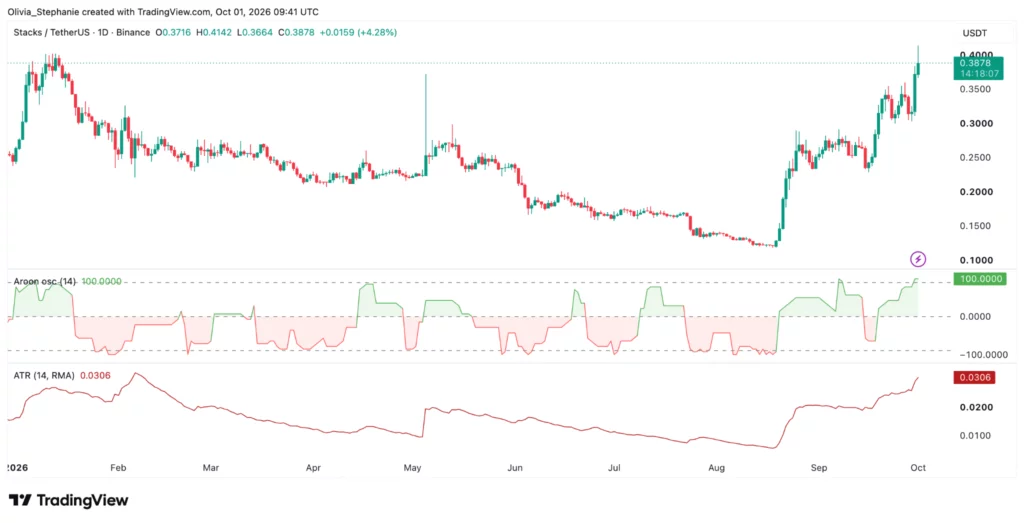
Volatility has increased at the same time. The 14-period Average True Range stands near $0.0306, equivalent to roughly 8% of the current STX price. ATR measures the size of price swings, not their direction, meaning larger daily moves can occur on either side.
Below current prices, roughly $0.35 is the first important area from the latest breakout. Holding above that level would preserve the recent higher-low structure visible on the daily chart, while a sustained drop beneath it would weaken the move that carried STX toward $0.40.
On the upside, $0.40 remains the immediate psychological level, followed by the recent $0.4142 high. Price has already encountered selling around that area, making a confirmed close above it more useful than an intraday move alone when assessing whether the rally is extending.
Stacks’ next identifiable protocol event is the Oct. 10 opening of Bonding Period 2, when the Bitcoin staking program is scheduled to increase capacity to 500 BTC. Stacks says the rate and capacity during this bootstrap phase are set by the Stacks Endowment.
Disclosure: This article does not represent investment advice. The content and materials featured on this page are for educational purposes only.