


BlackRock said in an August 2026 research report that Bitcoin’s decline of more than 50% from its October 2025 record did not change the asset manager’s long term investment case.
Summary
- Bitcoin fell more than 50% from October 2025’s record before reaching June lows below $60,000.
- Futures open interest exceeded $90 billion, with offshore perpetual contracts representing approximately 80% at peak.
- Spot Bitcoin ETPs lost roughly $5 billion after attracting $60 billion through October 2025 previously.
- Strategy sold 1,690 BTC in August, using $108.6 million to repurchase preferred shares during weakness.
- BlackRock’s historical analysis found 1% to 2% allocations improved hypothetical portfolio risk adjusted returns historically.
The firm attributed the correction to excessive leverage, weaker institutional flows and slower purchasing by digital asset treasury companies. Its paper described the decline as a positioning and liquidity event rather than evidence that Bitcoin’s monetary or diversification properties had structurally changed.
BlackRock’s view is an investment assessment, not a prediction that prices will recover. The firm also manages the iShares Bitcoin Trust ETF and warned that Bitcoin remains volatile, speculative and capable of causing a total loss.
Bitcoin’s $90 billion leverage buildup amplified losses
Bitcoin climbed from $15,765 in late 2022 to a record $124,606 in October 2025, according to BlackRock’s Bloomberg and Coin Metrics data. Futures open interest exceeded $90 billion near the peak.
Approximately 80% of that exposure came from perpetual futures outside CME. Some platforms offered leverage of between 50 and 125 times, leaving traders vulnerable to automatic liquidation following relatively small adverse price moves.
The first major unwind followed U.S. tariff announcements involving China on Oct. 10, 2025. Bitcoin fell 6%, while open interest declined by $20 billion in one day. BlackRock described this as the largest daily open interest reduction in the data reviewed.
Further liquidation waves followed in February and June 2026, eventually pushing Bitcoin below $60,000. The sequence supported BlackRock’s argument that leverage accelerated the decline, although it does not prove that positioning was the only cause.
The U.S. derivatives market has also changed since the selloff. The CFTC approved KalshiEX’s onshore Bitcoin perpetual contract in May, finding that its structure complied with federal derivatives rules. The order brought a product long associated with offshore exchanges into a regulated U.S. market.
ETP outflows and AI funds competed for capital
Spot Bitcoin ETPs attracted approximately $60 billion between their January 2024 U.S. launch and October 2025, BlackRock found. The products then recorded roughly $5 billion in aggregate outflows through July 2026.
Over the later period, AI themed funds attracted more than $46 billion. BlackRock said the rotation “likely competed for capital” and became a drag on Bitcoin allocations. The wording reflects the firm’s interpretation because fund flow data alone cannot establish why every investor moved money.
The rotation was also visible in retail and institutional attention. As previously reported, both Bitcoin fund withdrawals and declining crypto search interest coincided with stronger interest in AI equities.
Recent U.S. fund data has been more constructive but remains uneven. Farside data showed $297.5 million of net inflows on Aug. 17 and $189.3 million on Aug. 18. The combined $486.8 million followed approximately $385.2 million of withdrawals during the previous week.
Treasury sales added supply during the correction
BlackRock also identified sales by miners, large holders and digital asset treasury companies as sources of pressure. MARA sold 15,133 BTC for approximately $1.1 billion during March, according to its regulatory filing.
Strategy later adopted a Bitcoin monetization program allowing sales to fund reserves, dividends, interest payments and security repurchases. The program does not require the company to sell and has no fixed expiration date.
An Aug. 10 SEC filing confirmed that Strategy sold 1,690 BTC for $108.6 million between Aug. 3 and Aug. 9. It used the proceeds to repurchase STRC preferred shares.
The transaction provided a verified update to BlackRock’s discussion of treasury related selling. In related coverage, crypto.news examined how corporate treasury selling pressure has increasingly interacted with U.S. spot fund demand.
BlackRock retains its small allocation argument
BlackRock’s ten year historical test found that adding a 1% or 2% Bitcoin allocation to a traditional U.S. 60/40 portfolio improved hypothetical risk adjusted returns. A 1% allocation produced a Sharpe ratio of 0.90, compared with 0.81 for the benchmark. A 2% allocation produced a ratio of 0.96.
Maximum drawdowns were similar across the tests. The traditional portfolio recorded a 20.3% decline, compared with 20.6% for the 1% allocation and 20.9% for the 2% allocation.
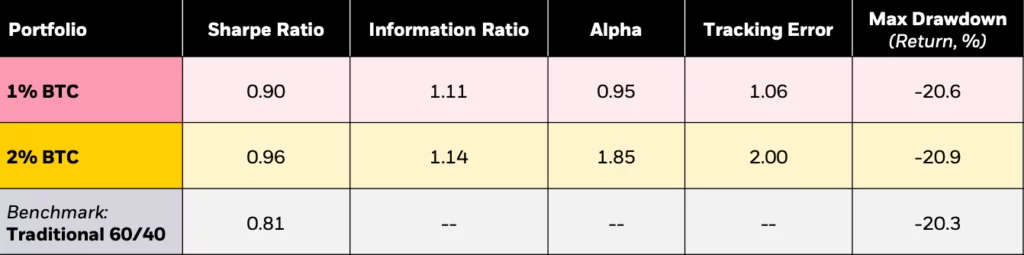
These results were hypothetical and benefited from hindsight. They did not include an actual BlackRock client portfolio and cannot establish how the allocations will perform in the future. Diversification also cannot prevent market losses.
BlackRock nevertheless said Bitcoin’s investment case “remains unchanged,” citing its capped supply, ten year correlation of 0.18 with the S&P 500 and possible use as a hedge against declining fiat purchasing power.
Bitcoin traded near $64,300 on Aug. 19 after reclaiming $64,000. As crypto.news reported, the latest price recovery coincided with renewed ETP inflows, although increasing leverage left the move exposed to another reversal.
The next evidence will come from ETP flows, futures positioning and corporate disclosures. Sustained inflows and lower speculative leverage would support BlackRock’s cyclical correction argument. Renewed liquidations or continued treasury sales would keep pressure on that assessment.
Disclosure: This article does not represent investment advice. The content and materials featured on this page are for educational purposes only.