

CLARITY Act passage odds have fallen to 25% as the White House reviews a bipartisan ethics proposal that could determine whether the Senate takes up the crypto market structure bill before its August recess.
Summary
- Polymarket traders give the CLARITY Act a 25% chance of becoming law in 2026.
- Anthony Scaramucci expects President Donald Trump to approve the bipartisan ethics proposal.
- Sens. Thom Tillis and Ruben Gallego reportedly submitted the compromise language to the White House.
- Senate leaders have not confirmed the timing of any floor action.
Scaramucci expects Trump to approve ethics deal
SkyBridge Capital founder Anthony Scaramucci said he expects Trump to accept the revised ethics language negotiated by Republican Sen. Thom Tillis and Democratic Sen. Ruben Gallego.
“If POTUS ultimately signs off, which I think he will, who will stand in the way of Clarity?” Scaramucci wrote on X. “If Dems (or GOPs in the pocket of bank lobby) stand in the way, they will regret it in November.”
Scaramucci’s statement represents his assessment of the negotiations. Neither Trump nor the White House has publicly confirmed acceptance of the proposal.
Tillis and Gallego reportedly sent the counterproposal to the White House on Thursday. The text has not been released publicly, but crypto journalist Eleanor Terrett reported that it would give state attorneys general a role in enforcing restrictions on federal officials’ digital-asset activities. Terrett’s report said the full scope of those state powers remained unclear.
Scaramucci also claimed in a now-deleted post that Trump’s children supported the compromise. That assertion has not been independently confirmed.
Ethics dispute remains central to CLARITY Act talks
Senate Democrats objected to an earlier Republican-backed ethics proposal because it reportedly placed enforcement authority solely with federal prosecutors.
The disputed language would restrict the president, vice president and other federal officials from issuing or sponsoring digital assets while in office. Democrats have sought stronger enforcement mechanisms and broader protections addressing conflicts of interest linked to officials’ crypto businesses.
Giving state attorneys general enforcement authority could help attract Democratic votes. It could also address concerns raised by Tillis, who had withheld support without changes to the ethics section.
However, an agreement on ethics would not guarantee passage. Senators remain divided over other provisions involving stablecoin rewards, protections for blockchain developers, and the division of regulatory authority between the Securities and Exchange Commission and Commodity Futures Trading Commission.
The House passed its version of the CLARITY Act by a 294–134 vote in July 2025, with 78 Democrats supporting it. Any amended Senate version would still need approval from both chambers before reaching Trump’s desk.
CLARITY Act odds fall to record-low 25%
Polymarket traders now assign a 25% probability that Trump will sign the CLARITY Act into law before the end of 2026, down from 30% earlier this week. The decline reflects uncertainty over both the remaining negotiations and the limited Senate calendar.
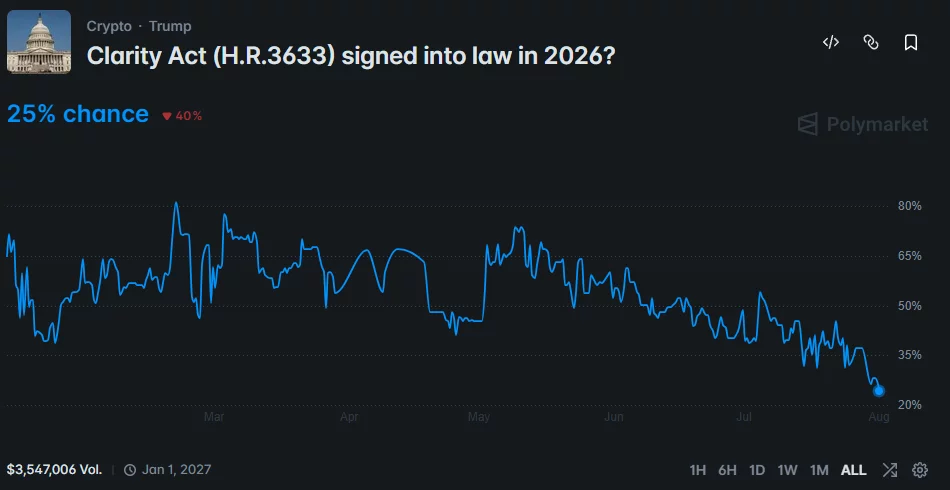
Prediction-market probabilities represent traders’ positions rather than a formal legislative forecast. The odds can change quickly if the White House accepts the ethics compromise or Senate Majority Leader John Thune schedules floor proceedings.
Industry groups are also pressing lawmakers to act. Digital Currency Group, the parent company of Grayscale, sent a letter to Thune and Senate Minority Leader Chuck Schumer requesting a vote before the recess. The company argued that continued regulatory uncertainty was driving US crypto investment and jobs overseas.
Treasury Secretary Scott Bessent issued a similar call this week, saying the Senate needed to vote on the legislation “now.”
Senate timetable remains uncertain
Sen. Cynthia Lummis said Thune has reserved space for the CLARITY Act on the Senate agenda and still intends to begin considering it before lawmakers leave Washington.
“Senator Thune has kept a place for the Clarity Act on the agenda before the August recess for many, many weeks now,” Lummis said. “I believe he does intend to go through with it.”
Still, no floor schedule has been confirmed. Nominations, government funding negotiations and votes concerning Iran and Russia-Ukraine sanctions are competing for the Senate’s remaining time. Lummis’ comments indicate that proceedings could begin within days, but they do not guarantee a final passage vote before the recess. Crypto.news previously reported that amendments and procedural votes could push final action into the post-recess calendar.
For US crypto companies and investors, the outcome will determine whether Congress advances a federal division of SEC and CFTC oversight this summer or leaves the regulatory framework unresolved heading into the November elections.