


SpaceX’s market value has climbed past $2.43 trillion on the second day of its Nasdaq debut, pushing the stock far beyond several pre-listing valuation estimates and cementing its place among the world’s most valuable public companies.
Summary
- SpaceX’s valuation climbed to roughly $2.43 trillion as shares surged more than 16% on the second day of trading.
- The stock traded near three times Morningstar’s $63 fair value estimate, defying several pre-IPO valuation concerns.
- ARK Invest bought $444 million worth of SpaceX shares, while Michael Saylor highlighted the company’s 18,712 BTC holdings.
According to Yahoo Finance data, shares of Elon Musk’s rocket and satellite company rose over 16% on Monday to $187.5 in afternoon trading. The move added about $26 per share in the session and lifted SpaceX’s intraday valuation to approximately $2.43 trillion.
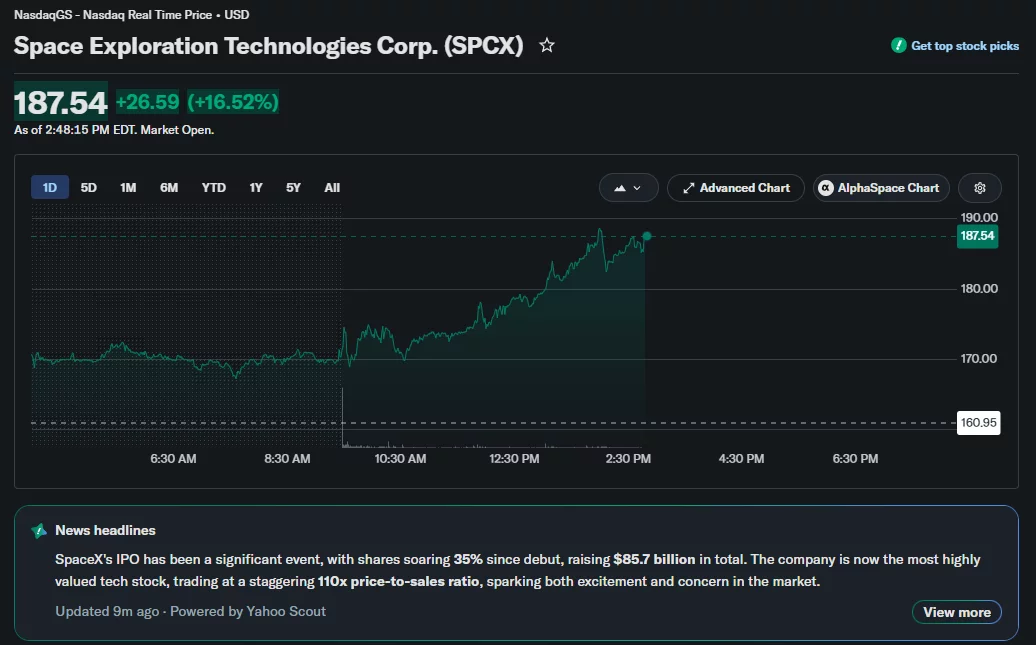
Trading activity remained elevated during the stock’s second session. Yahoo Finance data showed the shares opening at $171.81 and reaching an intraday high near $188.80, while volume surpassed 196 million shares. The gains extended a rally that began immediately after the company’s historic market debut.
Wall Street valuation concerns have not slowed demand
Before the listing, several analysts and market commentators questioned whether SpaceX’s valuation could be justified given the company’s financial profile. Morningstar estimated a fair value of $63 per share, a figure that sat well below the company’s $135 offering price. SpaceX has since climbed to nearly $188, trading at almost three times that estimate.
Investor appetite has moved in the opposite direction. As previously reported, SpaceX raised roughly $75 billion by selling more than 555 million shares at $135 each in the largest IPO on record. The stock opened at $150 on its first trading day, climbed as high as $176.52, and finished more than 19% above the offer price.
Reports surrounding the offering also highlighted concerns that a deal of such size could struggle to attract sufficient demand. Instead, orders reportedly exceeded available shares by a substantial margin, helping SpaceX surpass a $2 trillion valuation during its first days as a public company.
Even with the rally, questions about fundamentals remain. Notably, SpaceX generated $18.7 billion in revenue last year while posting a loss of $8.7 billion between the beginning of 2025 and March 31, 2026. MarketBeat data places the average one-year analyst price target near $161.25, below the stock’s current trading range.
Institutional investors continue backing the stock
While some analysts remain cautious, several high-profile investors have publicly supported SpaceX’s valuation. Kevin O’Leary has argued that investors are assigning value based on the company’s future opportunities rather than its current earnings.
Institutional demand has also accompanied the rally. As previously reported by crypto.news, Cathie Wood’s ARK Invest acquired 3,291,184 SpaceX shares across its exchange-traded funds on June 12, a purchase valued at roughly $444 million. The transaction ranked among ARK’s largest portfolio moves as the company entered public markets.
Meanwhile, SpaceX’s listing has drawn attention beyond traditional equity investors because of the company’s Bitcoin holdings. Commenting on the debut, Strategy Executive Chairman Michael Saylor said the IPO means 25% of the so-called Mag 8 companies now hold Bitcoin on their balance sheets. According to Bitcoin Treasuries data cited by crypto.news, SpaceX holds 18,712 BTC.
The listing has also strengthened Elon Musk’s position among the world’s wealthiest individuals. With SpaceX now trading publicly at a valuation above $2.4 trillion, the company ranks ahead of several established technology giants, including Meta, Samsung and Tesla, while remaining behind Nvidia by market value.