


Pi Network has climbed roughly 1.5% over the past 24 hours to around $0.0918 as traders watch a tightening price range and the Oct. 16 Protocol 28 Mainnet upgrade.
Summary
- PI trades near $0.0918 after gaining roughly 1.5% over the latest 24-hour period, CoinGecko shows.
- Protocol 28 is scheduled for Mainnet on October 16 after successful Testnet deployment this month.
- Analyst Crypto With Gopal identifies $0.10 resistance and $0.08 support inside a symmetrical triangle formation.
- RSI at 52.64 remains neutral while PI trades slightly above its 20-day Bollinger midpoint currently.
- KYC updates recently cleared 417,000 users while a separate fix targeted 497,000 previously stuck wallets.
CoinGecko shows PI trading near $0.0918 with approximately $6.1 million in 24-hour volume and a market capitalization of roughly $1.03 billion. Circulating supply stands near 11.24 billion PI, while the token remains almost flat over the past seven days.
The latest gain has kept PI above the $0.09 level after several September attempts to recover from the $0.08 area. Price action remains compressed beneath $0.10, where multiple rebounds have lost momentum during the month.
Pi Network price holds above its Bollinger midpoint
On the daily chart, PI is trading slightly above the 20-day Bollinger middle band at $0.08992. The upper band stands near $0.09897, while the lower band is around $0.08086.
The relatively narrow bands show that volatility has contracted compared with the larger price swings seen earlier in 2026. PI now sits in the upper half of the Bollinger range, leaving the 0.099-0.10 area as the nearest technical barrier.
Momentum has improved modestly. The 14-day Relative Strength Index stands at 52.64, above its moving average near 46.17. An RSI reading around 50 is generally neutral, while the move above its recent sub-40 level shows that selling pressure has eased on the chart.
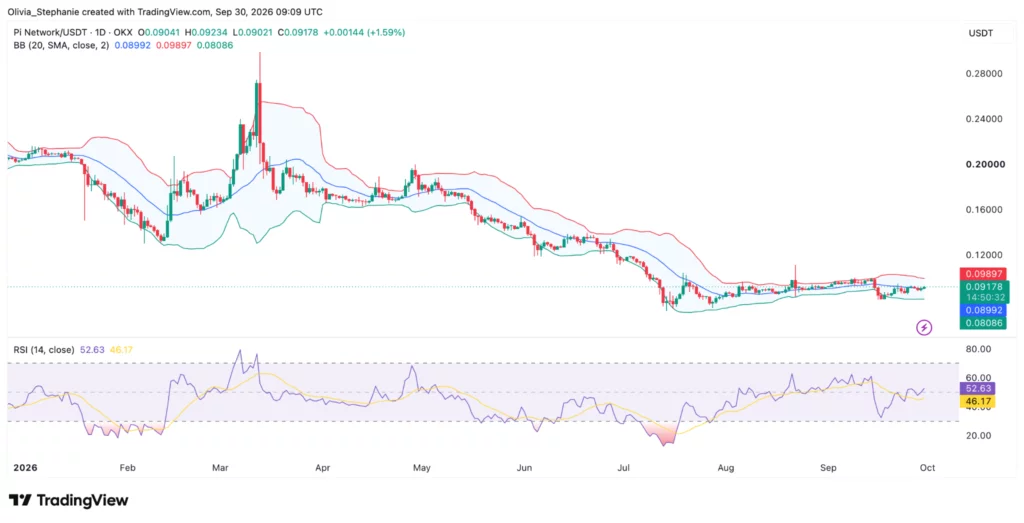
PI remains far below the levels reached earlier in 2026. CoinGecko data place the token around 97% below its $2.99 all-time high, while its current seven-day trading range sits between roughly $0.085 and $0.092.
Recent crypto.news coverage of PI’s failure to hold above $0.09 found the token trading below its major daily moving averages after an earlier rebound stalled. The current recovery has pushed PI back above $0.09, though $0.10 remains unbroken.
A triangle keeps $0.10 as the first breakout level
Crypto analyst Crypto With Gopal wrote that PI/USDT is forming a symmetrical triangle as price compresses between converging trendlines near $0.09.
The analyst identified a move above $0.10 as the level needed for stronger bullish momentum. A break below $0.08 could expose the token to further downside, according to the same analysis. Both levels remain conditional technical scenarios, not confirmed price targets.
On the daily chart, the 0.089-0.090 region serves as the closest trend reference because it lines up with the Bollinger middle band. The upper Bollinger Band near $0.099 sits directly beneath the analyst’s $0.10 breakout level.
A sustained move through $0.10 would therefore place PI above both the upper Bollinger region and the triangle resistance described by the analyst. Until that happens, the current chart continues to show consolidation between nearby support and resistance.
On the downside, $0.081 remains the lower Bollinger reference. Crypto With Gopal’s $0.08 breakdown level sits close to that area, creating a similar support range across the two technical readings.
Earlier crypto.news analysis of PI’s $0.10 resistance ahead of Protocol 28 found that the token had repeatedly failed to sustain moves through that level during September. At the time, the seven-day range extended from roughly $0.085 to $0.0945.
Protocol 28 puts October 16 on Pi Network’s calendar
Pi Network has completed Protocol 27 on Mainnet and moved Protocol 28 onto Testnet. The project’s official node page states that every Mainnet node must upgrade to version 28 as the network prepares for the next protocol change.
The Pi Core Team set Oct. 13 as the deadline for node operators to complete the upgrade, with Protocol 28 scheduled to reach Mainnet on Oct. 16. The announcement says the new protocol improves the handling of transaction-data delays and lets developers update groups of smart contracts together.
Protocol 28 is designed to give applications a safer way to modify stored data as their smart contracts develop. Testnet has already moved to the new version, leaving the Mainnet activation as the next scheduled protocol event.
The Oct. 16 timeline follows a series of upgrades throughout 2026. Protocol 25 introduced cryptographic features including BN254 and Poseidon hashing, while later versions continued work around smart contracts and network infrastructure. Pi Network’s July release said Protocol 25 was designed to support more efficient privacy-preserving smart contract functions.
The most recent crypto.news report on Protocol 28 preparations noted that Protocol 27 had already reached Mainnet before Testnet advanced to version 28. Node operators now have roughly two weeks until the Oct. 13 update deadline.
KYC fixes target more than 900,000 affected users
Outside price and protocol upgrades, Pi Network has continued working through KYC and Mainnet migration issues involving large groups of users.
Pi Network said more than 417,000 Pioneers previously flagged as possible duplicate accounts can now continue through KYC after additional checks determined they were separate users. The project cautioned that affected users still need to meet any remaining verification requirements.
A separate problem affected roughly 497,000 Fast-Track wallets. Pi said some users could not claim migrated balances because the wallets lacked enough PI to cover required gas fees. The team said a technical fix would unblock those accounts and prevent the same issue for future Fast-Track migrations.
The project introduced other KYC changes covering Yoti users with missing liveness-check data, owners of certain Indonesian IDs and people using older mobile devices. A one-month palm-print authentication trial was introduced for some users who need multiple liveness checks.
Previous crypto.news coverage of Pi Network’s KYC and wallet fixes affecting more than 900,000 users documented both the 417,000-account KYC group and the 497,000 Fast-Track wallet group while Protocol 27 testing was still progressing.
CoinGecko currently lists OKX, Gate, CoinW and several other exchanges among PI’s active markets. The page shows roughly $6.1 million in total daily trading volume, with PI remaining inside the same 0.08-0.10 range that has contained much of its trading since late July.